
Material changes volume from the cut to the truck to the fill. Here’s what to check in the geotech and the spec before you lock import, export and haul.
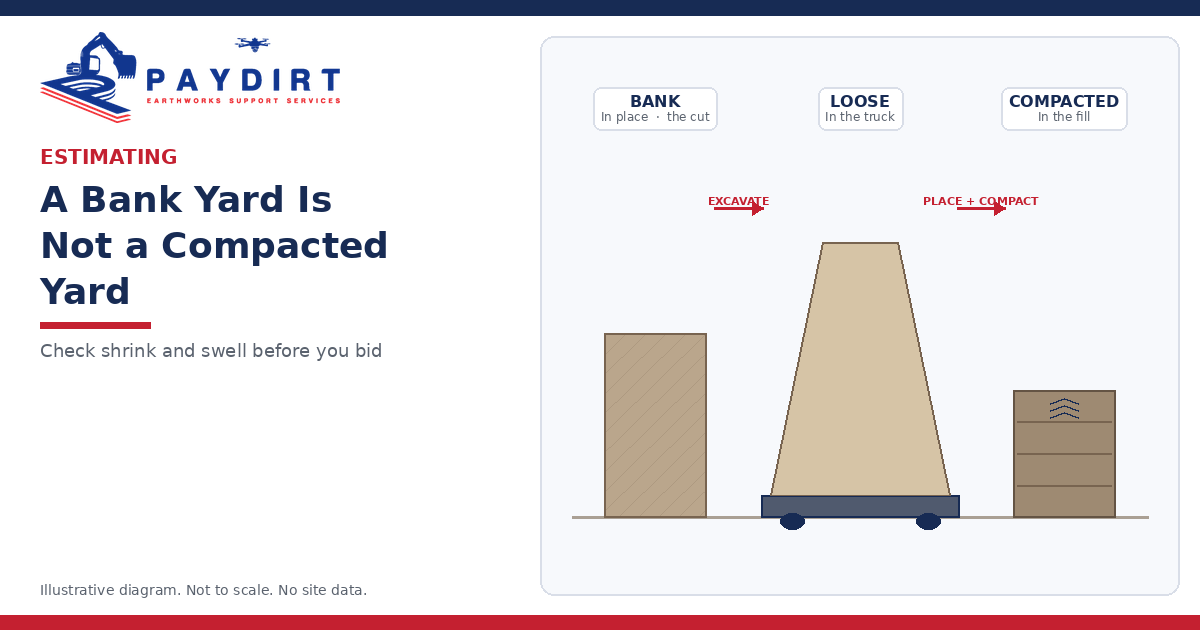
A bank yard is not a compacted yard. Check the shrink and swell factor before you bid.
A cut/fill takeoff tells you how many cubic yards sit in the ground, in place. That number is useful. It is not, by itself, the volume you will haul, or the volume that will land in the fill after compaction. Almost all materials change volume when they move from cut to truck to embankment. If you treat a bank cubic yard as if it were already a compacted cubic yard, import, export, truck counts and haul time all drift — and the miss shows up after award.
Federal Highway Administration guidance for Federal Lands highway design is direct on this point. Roadway excavation is typically measured in the original, undisturbed position, and the specifications must clearly state the place and method of measurement, because almost all materials change volume in their movement from cut to fill.
The same FHWA Earthwork Design page walks through the three states estimators actually price:
Excavated solid rock usually goes the other way. Placed in a fill, it typically occupies a larger volume than it did in place. That change is the swell. FHWA notes that when the voids in a rock embankment become filled with earth or other fine material, the volume in the fill will just about equal the combined volumes in the two source locations.
FHWA Federal Lands’ Earthwork Representation Guide uses the same language estimators use on a cut/fill report: shrink/swell factors adjust quantities from the bank (BCY) state to the compacted (CCY) state, and the factors to use are the ones recommended in the geotechnical report. Swell factors (values greater than one) are typically associated with rocky materials. Shrink factors (values less than one) are typically associated with clayey or granular materials.
FHWA publishes a table of shrinkage and swell values that “may be used for estimating purposes prior to obtaining the project specific information from the Geotechnical Unit.” The same page is explicit about the limits of that table: mass densities are subject to adjustment, a negative swell number represents shrinkage, and the factors are subject to substantial variation. The design, it says, should use data furnished by the geotechnical unit, and when they are available, actual field shrink and swell factors for like material used on adjoining projects.
For ranges, FHWA describes — not prescribes — the following, always dependent on the material and the work:
Those are FHWA’s published ranges for design context. They are not a substitute for the factor in your geotechnical report or the measurement rules in your specification. Shrink, as FHWA notes, can also include slight waste in transport, material that escapes beyond the toe of slopes, and the effect of slightly overbuilt embankments. Settlement of the ground under a new fill can contribute to an apparent shrink, but shrink should not be confused with subsidence of a weak foundation.
If the report is silent, or the spec measures excavation and embankment in different positions (bank versus compacted), that is a bid question, not a gap to fill with a favorite percentage.
Once the factor is wrong, several cost centers move at once.
Import and export. If compacted fill takes more bank cubic yards than a 1:1 takeoff assumed, the job can go from “balanced” to short, and you have borrow and haul you did not price. If the material shrinks less than you assumed, or swells, you can end up with waste, a dump site and trucking you did not carry. The takeoff surfaces do not make that adjustment by themselves.
Haul and production. Loose volume is what actually sits in the truck. Understating swell in the haul unit changes cycle times, truck counts and the time on the schedule to move the same bank quantity.
Place of measurement. If the specification measures excavation in the bank and embankment in the compacted position, the shrink/swell factor is how those two numbers meet. If both are measured in the same position, the factor still matters for equipment, moisture and whether on-site material will actually build the fill you planned.
Balance points. FHWA’s Earthwork Design guidance treats shrink and swell as part of balancing cut and fill, including the effect of subexcavation and reserved topsoil. A mass diagram built on unadjusted bank volumes will not match the work you have to perform.
Before you lock import, export and haul:
3 sets of eyes check every project before it reaches your desk.
Complete Bid Proposals. Field Knowledge. Ongoing Support.
If you want another look at the geotech and the grading plan before you bid, send us your plans.
Material changes volume from the cut to the truck to the fill. Here’s what to check in the geotech and the spec before you lock import, export and haul.
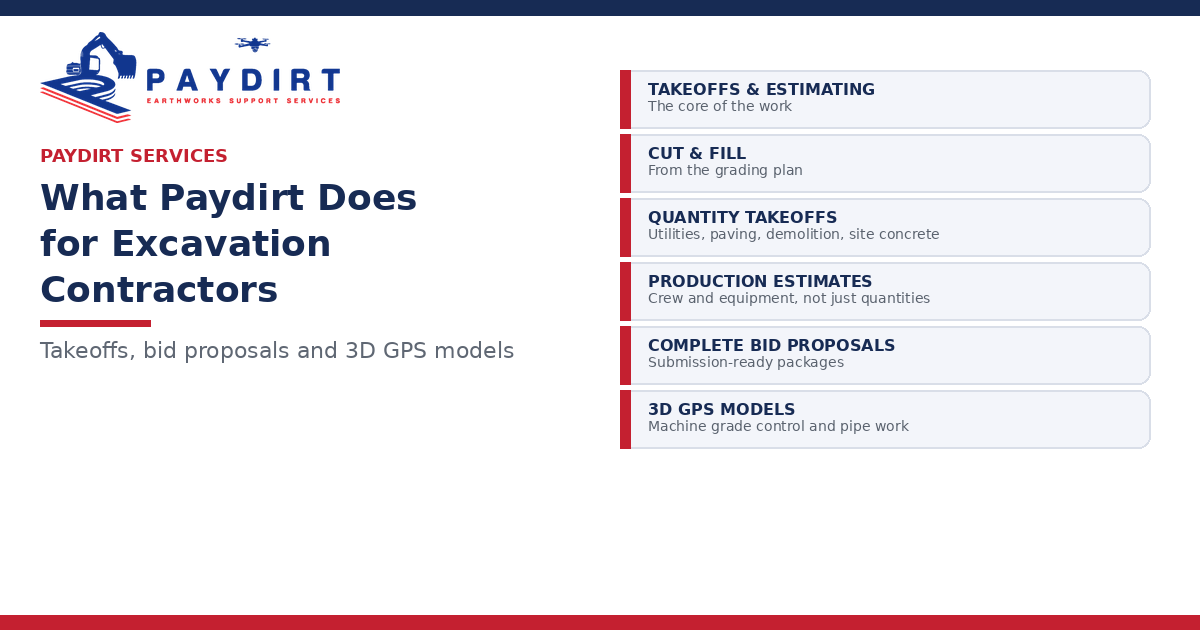
A clear look at what Paydirt does: takeoffs and estimating, production estimates, complete bid proposals and 3D GPS machine control models — with 3 sets of eyes on every project.
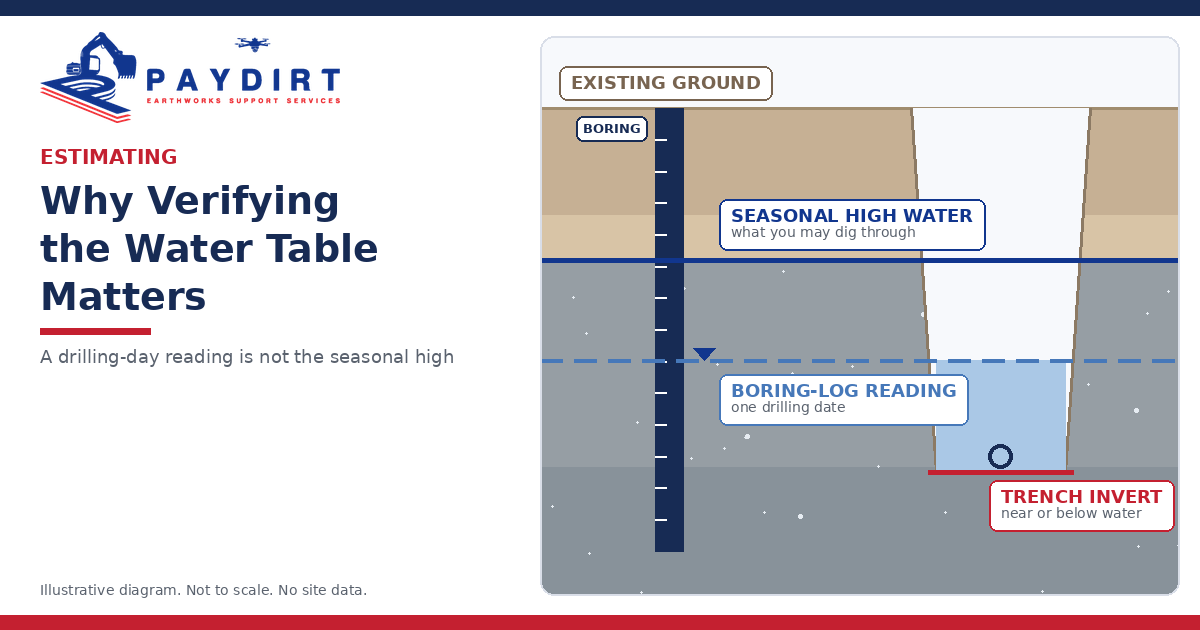
A water level recorded on one drilling date is not the same as the high water you’ll dig through. Here’s what to check before you lock the number.
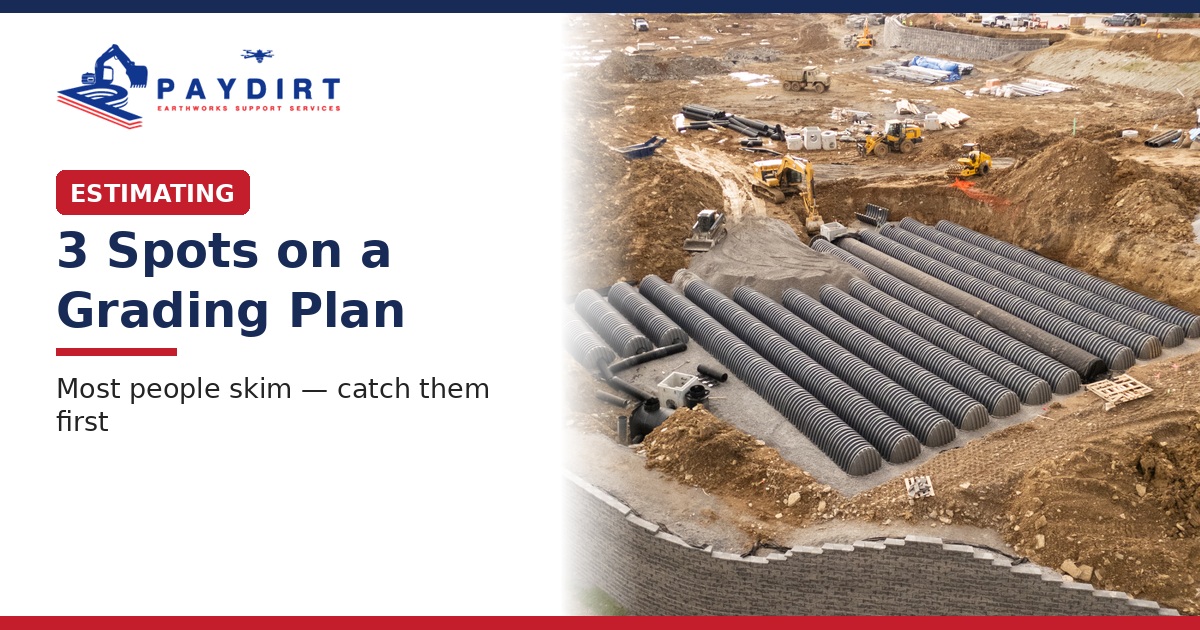
Most cut/fill misses hide in three spots on the grading plan: contours, spot elevations and margin notes. A five-minute desk check before you lock the number.
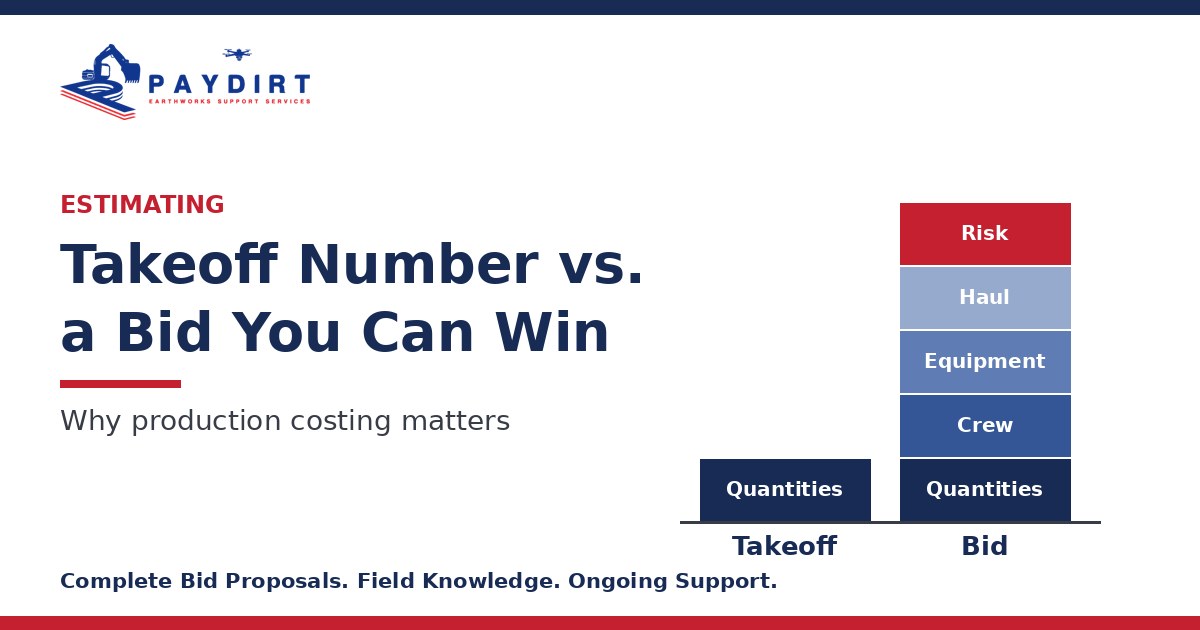
A takeoff tells you how much dirt. Production costing tells you what it costs to move it. Here’s how to turn excavation quantities into a bid you can win.