Material changes volume from the cut to the truck to the fill. Here’s what to check in the geotech and the spec before you lock import, export and haul.
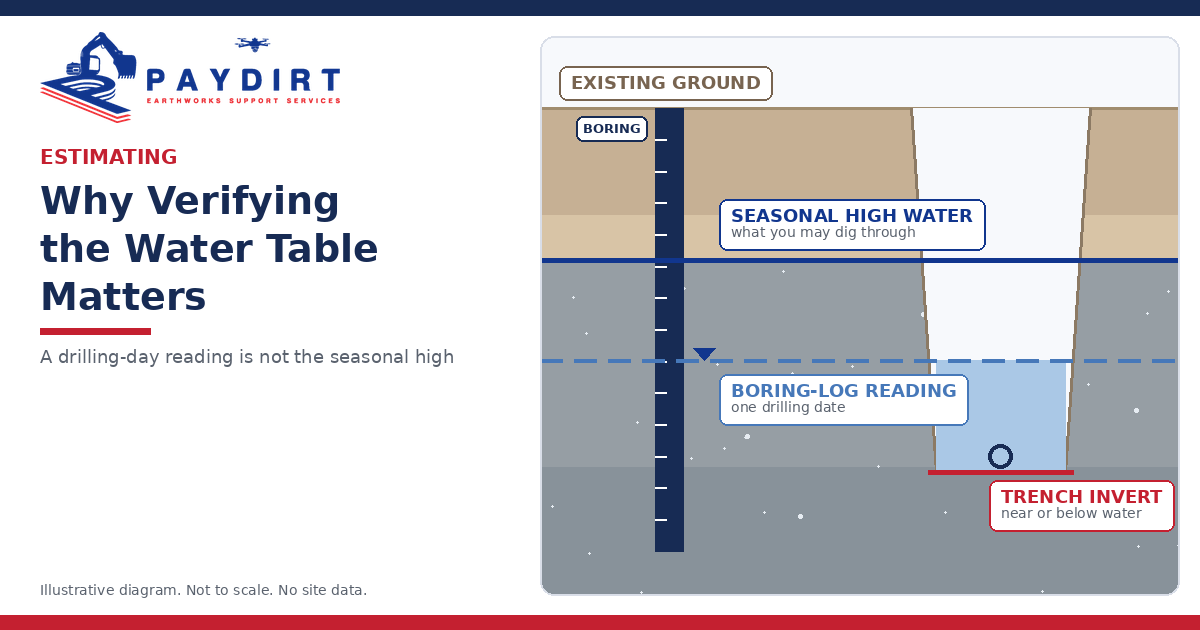
The water table on a boring log is a snapshot. Verify it before you bid.
A groundwater reading recorded on the day the drill rig was on site is useful. It is not, by itself, a complete picture of the water you may have to dig through, pump, haul or shore against. If your cut or trench invert sits near or below that water, the bid changes: dewatering, wet-soil handling, undercut, shoring or shields, pipe bedding and the schedule all move.
Your geotechnical report gives you the water level from the day the drill rig was on site. The water table itself can rise or fall depending on the time of year. In late winter and spring, snowmelt and rainfall recharge the ground and the water table rises. In hot, dry months, evapotranspiration can send it lower. The most reliable way to know the depth at a given time is to measure it, and the borehole water levels in the geotechnical report are the starting point.
For an estimator, that seasonal swing matters. A boring drilled in a dry month can understate the water a crew will see if the work happens during a seasonal high. Caltrans’ groundwater guidance makes the same practical point: a measurement in a boring represents groundwater at a single point in time and does not, by itself, show how much the level may change. Inaccurately represented groundwater can lead to design modifications, unforeseen environmental impacts and construction issues. Where seasonal fluctuation, tides, pumping or surface-water influence matter, piezometers or repeated readings are used to characterize the high water, not a single drilling-day observation. Caltrans also notes that in silts and clays, groundwater levels may not stabilize for several hours or days, and that perched groundwater can be present in some parts of a site and absent in others.
Look at the logs for more than one number. Field practice, and Caltrans’ measurement guidance, is to record groundwater when it is encountered and to keep measuring until a stable reading is recorded. First-encountered, end-of-drilling and delayed or stabilized levels often do not match. Also watch for a design or seasonal-high groundwater elevation the geotechnical engineer actually used, and for seepage, artesian or perched-water notes.
Once the invert is near or below the water table, several cost centers move at once, and every one of them is expensive if it’s missed in the bid. Dewatering, undercut, haul, shoring and shields are major cost items, and on a hard bid those costs come out of your margin.
Dewatering. The Federal Highway Administration’s construction inspection guidance tells reviewers to evaluate the contractor’s groundwater control plan when the water table is near the bottom of the excavation. Sump pumps are described as an option in cohesive soils; well points are described as an option in cohesionless soils, where the work is to control water without causing piping. The U.S. Bureau of Reclamation similarly notes that excavation near or below the water table usually requires groundwater control so the work can be built in the dry. Military and Navy dewatering guidance (Army TM 5-818-5 / NAVFAC P-418) describes a conventional well-point stage as generally capable of lowering the groundwater table about 15 feet, with additional stages when more drawdown is required. That is not a unit price in your proposal. It is the reason a dewatering method, a line item and time on the schedule need to be considered before you submit a number.
Wet soil, undercut and haul. Material excavated below the water table is not the same material a dry cut/fill takeoff assumed. It may be heavier to haul, harder to place and compact, or unsuitable for reuse as structural fill. That can mean undercut, replacement material, longer cycle times and a different export quantity. Price the handling you can see in the geotech, and flag what you cannot.
Shoring, shields and worker protection. OSHA’s excavation standard, 29 CFR 1926.651(h), prohibits employees from working in excavations with accumulated or accumulating water unless adequate precautions are in place. Those precautions can include special support or shield systems, water removal to control the level, or a safety harness and lifeline. If water-removal equipment is used, a competent person must monitor it. OSHA’s soil classification in Appendix A to Subpart P treats submerged soil, or soil from which water is freely seeping, as Type C — the least stable of the four categories. Type C changes sloping, shielding and trench-box assumptions. OSHA also requires a competent person to inspect excavations after rainstorms and other hazard-increasing events. OSHA’s trenching booklet lists location of the water table, surface and ground water, and the quantity of shoring or protective systems among the factors employers should consider when bidding a job.
Pipe bedding and backfill. Water in the trench changes how bedding is placed, whether the trench can be kept stable, and whether backfill can be compacted to spec. If the specification assumes work in the dry, a water table near the invert is not a footnote. It is a production and material issue.
Schedule and change orders. Dewatering systems take time to install, run and maintain. Wet subgrades slow production. A peer-reviewed study of geotechnical change orders on U.S. roadway projects, Identification of Geotechnical-Related Factors Impacting Cost, Schedule, and Claims on Roadway Construction Projects, ranked a higher-than-anticipated groundwater table and dewatering because of seepage issues among the six most important geotechnical change-order drivers affecting cost, schedule and claims. Verifying the water table before bid day is one of the chances to get those risks into the number, or into a clear qualification, instead of discovering them after award.
Before you lock quantities and production:
3 sets of eyes check every project before it reaches your desk.
Complete Bid Proposals. Field Knowledge. Ongoing Support.
If you want another look at the geotech and the grading plan before you bid, send us your plans.
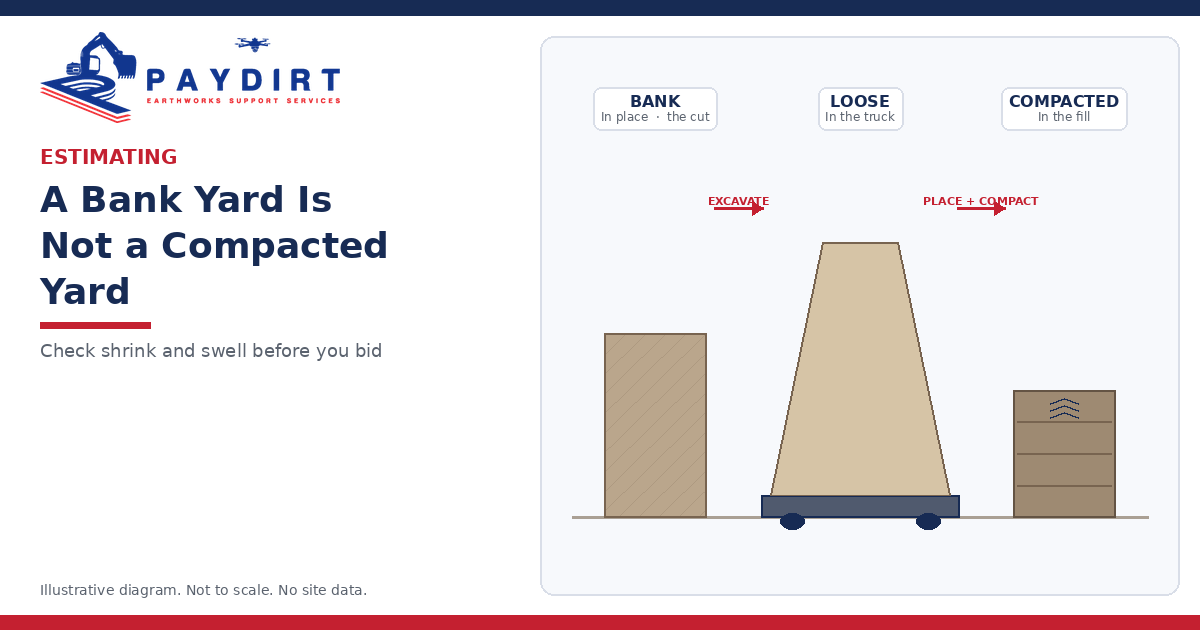
Material changes volume from the cut to the truck to the fill. Here’s what to check in the geotech and the spec before you lock import, export and haul.
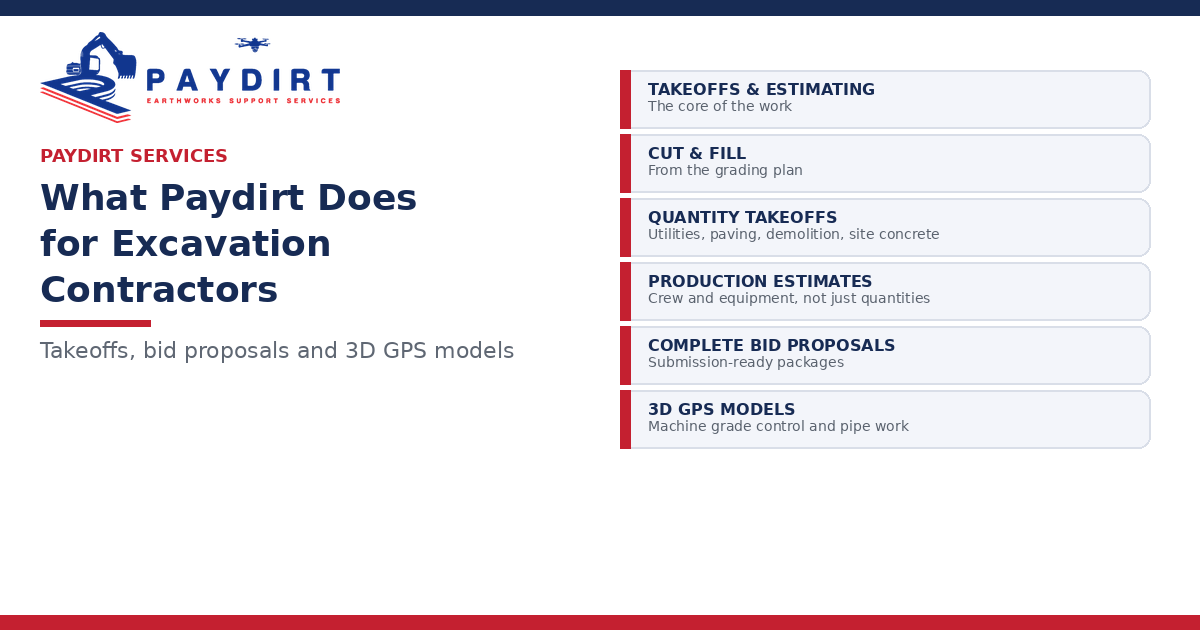
A clear look at what Paydirt does: takeoffs and estimating, production estimates, complete bid proposals and 3D GPS machine control models — with 3 sets of eyes on every project.
A water level recorded on one drilling date is not the same as the high water you’ll dig through. Here’s what to check before you lock the number.
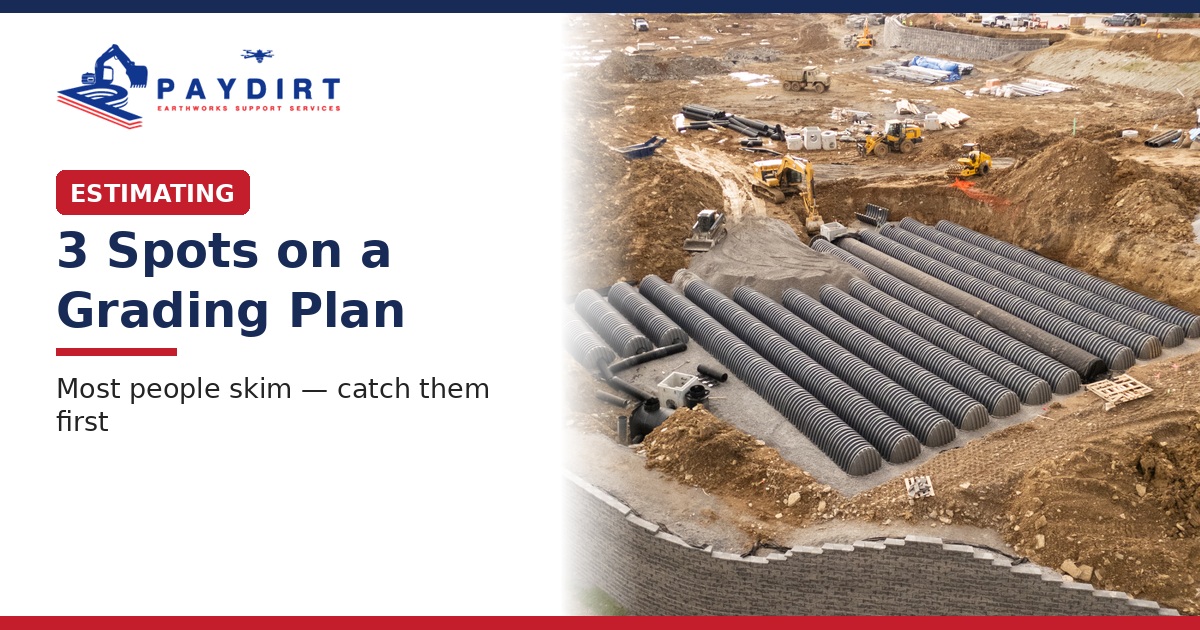
Most cut/fill misses hide in three spots on the grading plan: contours, spot elevations and margin notes. A five-minute desk check before you lock the number.
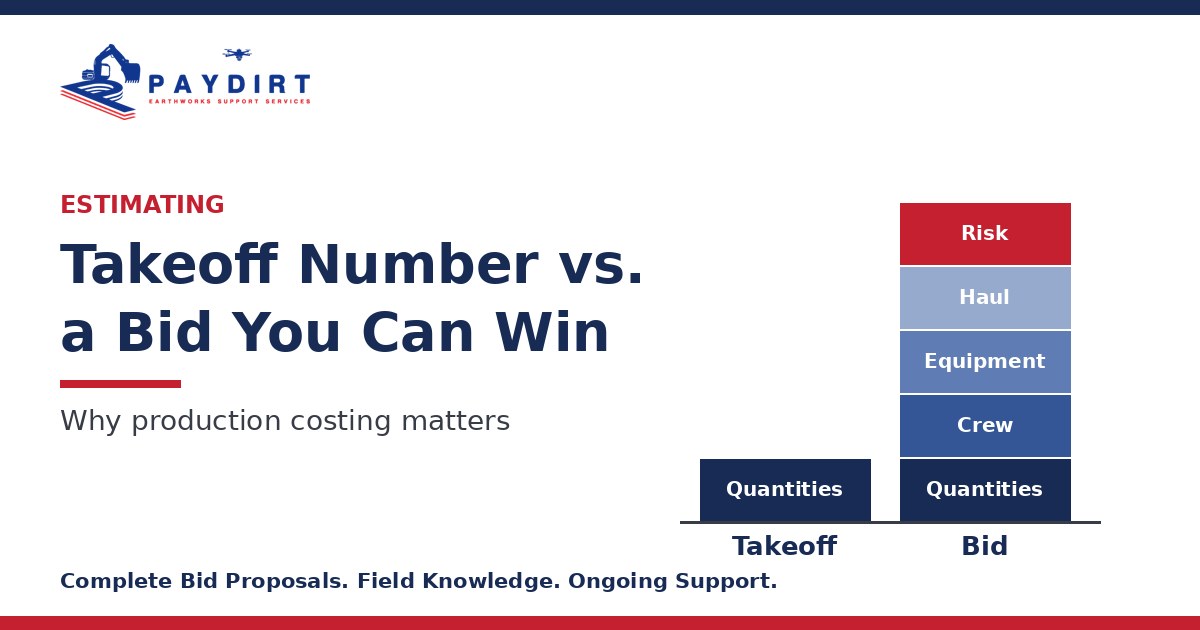
A takeoff tells you how much dirt. Production costing tells you what it costs to move it. Here’s how to turn excavation quantities into a bid you can win.