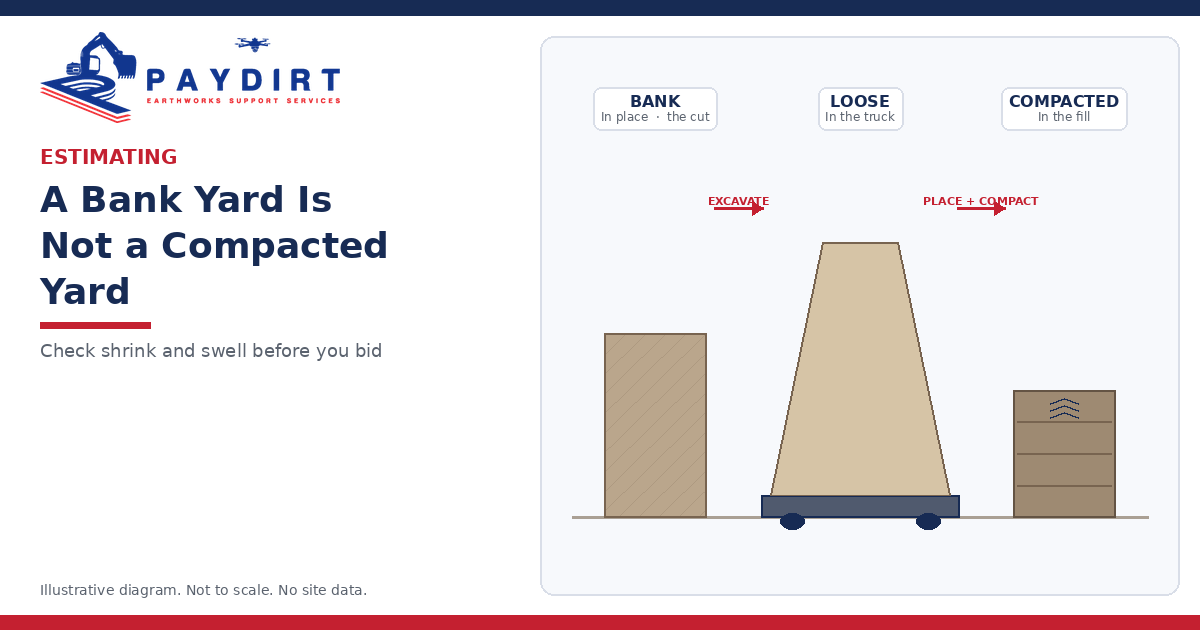
Material changes volume from the cut to the truck to the fill. Here’s what to check in the geotech and the spec before you lock import, export and haul.
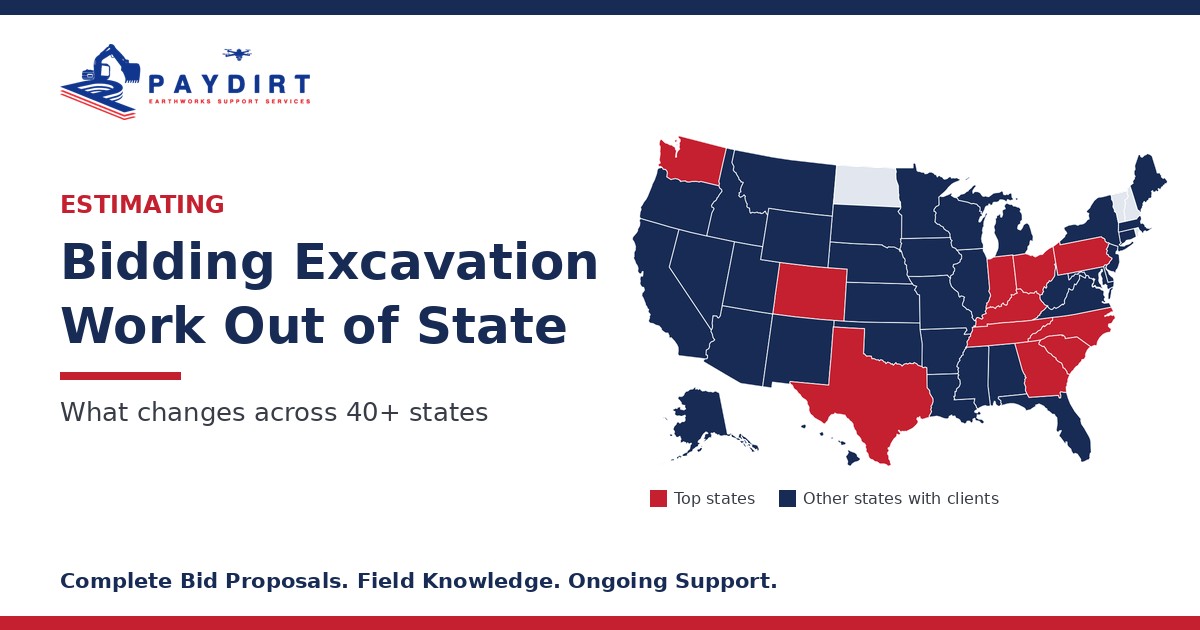
Winning work in a new state can grow your business fast, but the plans, specs and soils don’t always read the way they do at home. We work with excavation and civil contractors in 40+ states, and some of our top states are North Carolina, Georgia, South Carolina, Ohio, Tennessee, Indiana, Texas, Pennsylvania, Kentucky, Colorado and Washington. Every one of those markets has its own habits. Here’s what we check when a job crosses a state line. Bidding one now? Send us your plans.
Before you price a single yard, find out which specs govern the job. Many site projects lean on the state DOT’s standard specifications for things like embankment, subgrade preparation, aggregate base and compaction testing, even when the owner is private. The section numbers, the testing frequency and the acceptance criteria are not the same from one state to the next. Read the general notes on the cover sheet and the spec book reference, then pull the sections that touch your scope. A bid built on your home state’s standard can miss a requirement that changes how you place and test material.
Soil types, groundwater and bearing notes shift from region to region. Clay that behaves one way in one market can be a very different problem a few states over, and a site with a shallow water table changes how you dig, dewater and haul. Read the full geotechnical report, not just the summary page. Look at the boring logs, the groundwater readings and the recommendations for subgrade, fill placement and undercut. Those pages drive your excavation quantities and your production assumptions.
How the dirt behaves changes the balance. Material that bulks when you dig it or compacts tighter when you place it will move your import and export numbers, sometimes enough to turn a balanced site into a haul job. Don’t carry a shrink or swell factor over from your last job in another state. Check whether the geotech report gives factors for the site, note them on your takeoff, and flag the assumption in your bid if the report is silent.
Stripping depth is one of the easiest places to lose money on an out-of-state job. Confirm what the plans and specs call for instead of assuming your home-state habit. Look for a stripping depth in the geotech report, the grading notes or the spec, and check whether topsoil gets stockpiled and respread or hauled off. A small change in depth across a large site adds up to a real quantity of material to move.
Look for where the geotech flags soft or unsuitable soils and how it’s handled. Some reports call out specific areas for undercut and replacement. Others leave it to field decisions during construction. Either way, your bid needs to show how you treat it: a quantity carried in the base bid, a unit price, or a clear clarification. On a new market, that line item protects you from soils you haven’t worked before.
State and local erosion control and stormwater requirements change what goes into the bid. Permit conditions, inspection requirements, inlet protection, silt fence, sediment basins and stabilization timelines vary by state and sometimes by county. Read the erosion control sheets and the permit notes carefully, and make sure the phasing they require lines up with how you plan to run the excavation.
Haul routes, dump sites and borrow sources are new when you’re new to the area. You may not know where the nearest place to take spoils is, what it charges, or where to get approved fill. Those answers drive trucking costs as much as the quantities do. Use the cut and fill balance from your takeoff to decide early whether the job is an import job, an export job or close to balanced, then price the haul with real local options.
Read every addendum. Owners and engineers in each market do things their own way, from how they issue revisions to what they expect in a bid form. A late addendum can change grades, add a sheet or swap a spec section. Check that your takeoff is built on the latest revision of every sheet, and note the addenda you priced in your proposal.
The specs and soils change from state to state, but your quantities shouldn’t depend on where the job is. With Paydirt, you get US-based project management and QC on every estimate, backed by our dedicated production team. 3 sets of eyes check every project before it reaches your desk, so the numbers you carry into a new market are checked the same way as the ones you bid at home.
Quantities are the start, not the finish. Paydirt turns the numbers into a complete bid proposal you can submit with confidence: excavation takeoffs, cut and fill, utility quantities, production estimates and 3D GPS machine control models when the job calls for them. Wherever the job is, the process is the same. Send us your plans.
A new state is a chance to grow, and the right prep keeps it from becoming a costly lesson. Check the specs, read the geotech report, confirm stripping and undercut, price the haul with local options and read every addendum.
Send us your plans through our work order request form (https://paydirtsupport.com/work-order-request-form/), or call 843-900-1002.
Paydirt: Complete Bid Proposals. Field Knowledge. Ongoing Support.
Material changes volume from the cut to the truck to the fill. Here’s what to check in the geotech and the spec before you lock import, export and haul.
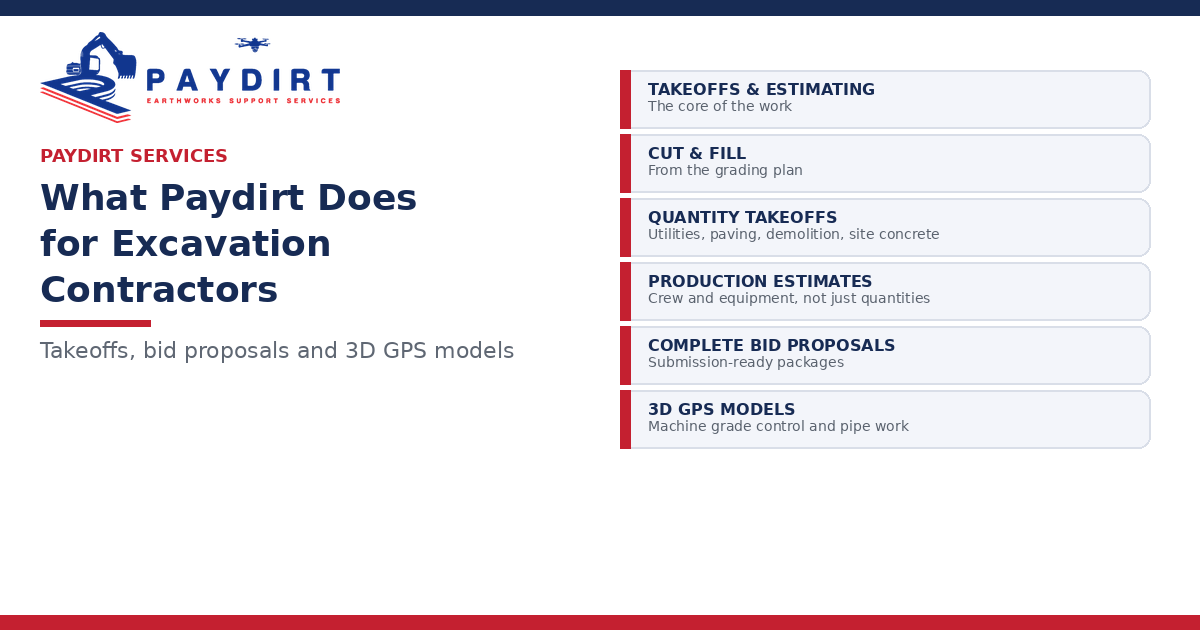
A clear look at what Paydirt does: takeoffs and estimating, production estimates, complete bid proposals and 3D GPS machine control models — with 3 sets of eyes on every project.
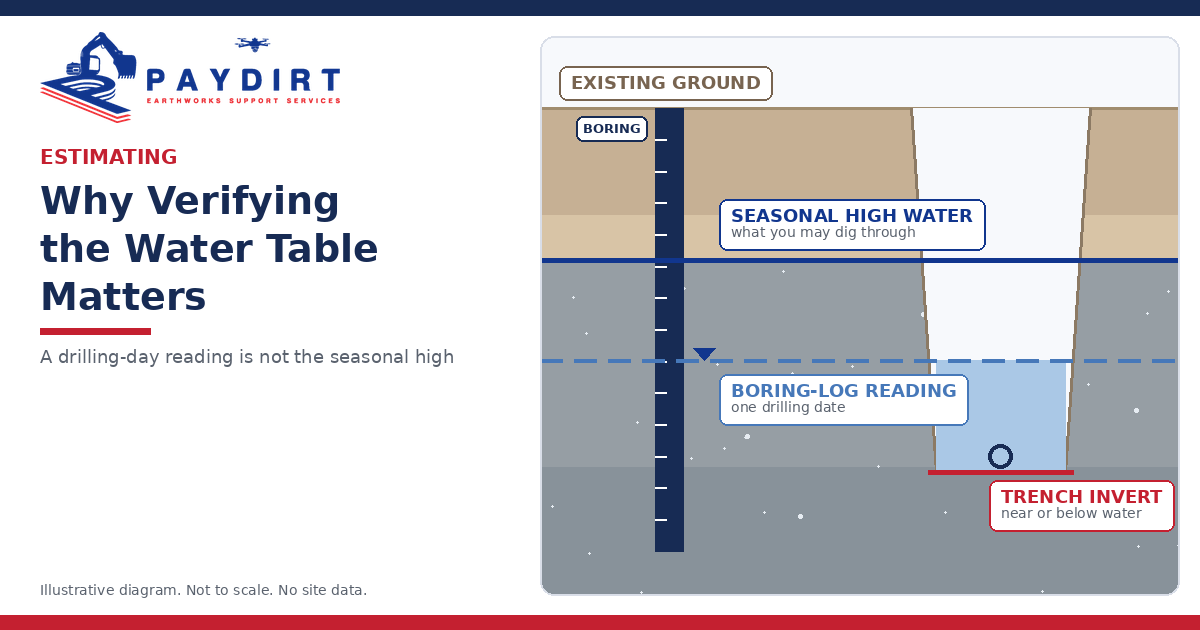
A water level recorded on one drilling date is not the same as the high water you’ll dig through. Here’s what to check before you lock the number.
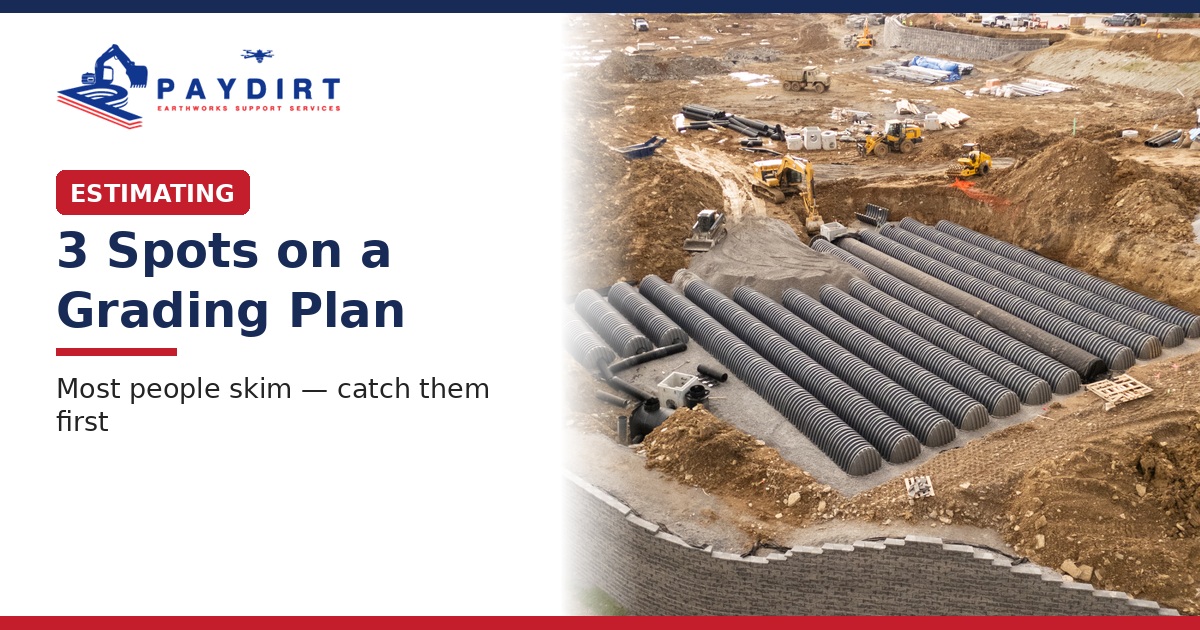
Most cut/fill misses hide in three spots on the grading plan: contours, spot elevations and margin notes. A five-minute desk check before you lock the number.
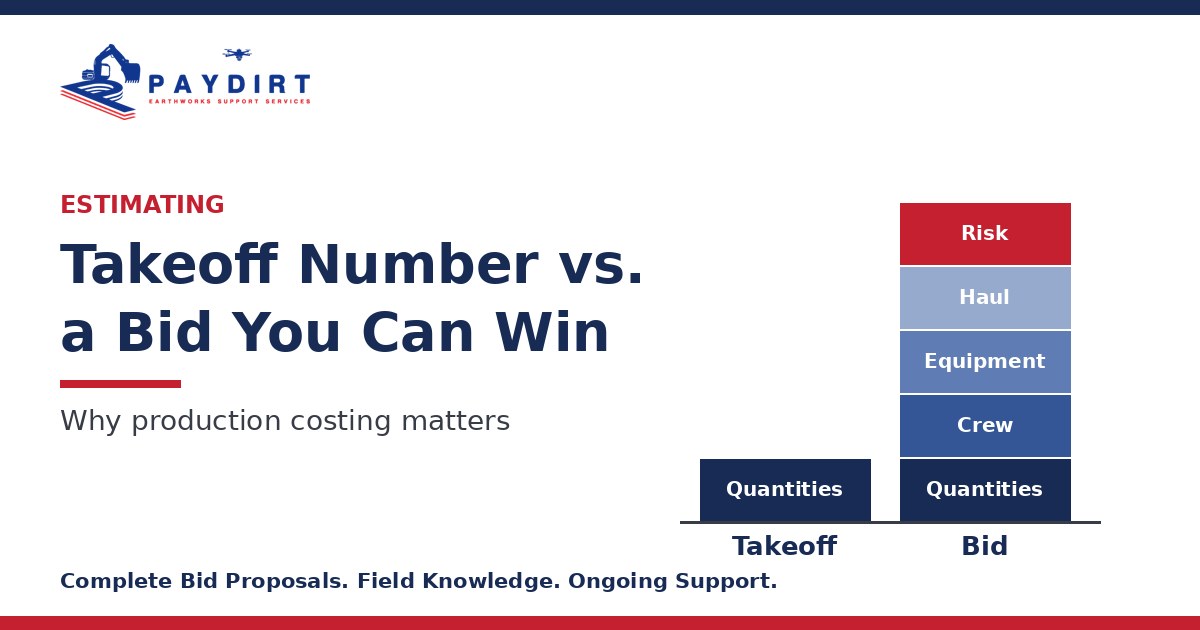
A takeoff tells you how much dirt. Production costing tells you what it costs to move it. Here’s how to turn excavation quantities into a bid you can win.