Material changes volume from the cut to the truck to the fill. Here’s what to check in the geotech and the spec before you lock import, export and haul.
Most bad excavation bids don't come from bad math. They come from something nobody checked before the math started: a missing sheet, an old revision, a geotech note buried on page 40.
This is the checklist we run through before we price a job. Use it as it is or fold it into your own process.
✔ 1. Confirm you have the full, current set. Check the sheet index against what you actually received and look at the revision date on every sheet. If the civil set is on Rev 3 and the grading sheet says Rev 1, stop and ask.
✔ 2. Read the addenda before the plans. Addenda change quantities, specs, and sometimes scope, so read them first and you won't price something that's already been deleted or changed.
✔ 3. Check the scope split. Who owns erosion control, building pad prep, utility connections at the building, and paving base? Write down where your scope stops. Gaps and overlaps between trades are where money disappears.
✔ 4. Verify the existing surface. Find out where the existing topo came from and how old it is. A survey from a few years ago may not show stockpiles, cleared areas, or work done since. If the surface is wrong, every cut/fill number built on it is wrong too.
✔ 5. Account for topsoil stripping. Look for the specified stripping depth, and ask if there isn't one. Stripping changes your cut/fill balance more than many people expect, and it's one of the items most often left out of takeoffs.
✔ 6. Look at subgrade, not just finish grade. Calculate cut/fill to subgrade: finish grade minus pavement sections, slab sections, and topsoil. Pricing to finish grade can overstate or understate the dirt, depending on the site.
✔ 7. Decide on shrink and swell. Pick your factors and write them down with the reason. Use the geotech's guidance if it gives any. If it doesn't, note your assumption in the bid.
✔ 8. Read the whole geotech report. Look for groundwater depth, rock, unsuitable soils, undercut recommendations, and moisture issues, then compare those notes to the grading plan. If the plan has you cutting below the depth where the borings hit water or rock, that needs a line item or a clarification.
✔ 9. Walk or review the site. A site walk, photos, or aerial imagery will show access problems, existing structures, trees, and drainage that the plans don't. Note haul routes and where spoils can go.
✔ 10. Take off utilities by system, with depths. Storm, sanitary, and water each need lengths, sizes, structures, and depths. Depth drives trench volume, shoring, and production rates. Check for conflicts where lines cross.
✔ 11. Check tie-in points and existing utilities. Confirm where you connect to existing lines and who's responsible for each connection. Look for existing utilities that need to be protected, relocated, or abandoned.
✔ 12. Get a second (and third) set of eyes. The person who did the takeoff is the worst person to catch its mistakes. At Paydirt, every project gets 3 sets of eyes: the takeoff, a check, and a final QC review, with US-based project management and QC on every estimate, backed by our dedicated production team. You don't need our exact process, but someone other than the estimator should review the quantities before a bid goes out.
Turn these 12 items into a one-page sheet and check them off on every job. Write down every assumption you make, like stripping depth, shrink/swell, and scope exclusions, and put them in your bid qualifications. If something goes sideways later, you'll be glad they're on paper.
Before you price your next job, ask one question: what did we assume, and did anyone check it? Most surprises on excavation jobs trace back to an assumption nobody wrote down.
Need a hand before bid day? Paydirt can run your cut/fill and utility takeoffs, build the production estimate, turn it into a complete bid proposal, and prepare 3D GPS models for your machines. Most takeoffs come back in 2–4 business days once your order is confirmed and paid, and rush is available. Contact us at paydirtsupport.com/contact to talk about your next project.
Paydirt: Complete Bid Proposals. Field Knowledge. Ongoing Support.
75 Aiken Street, Unit 100, Charleston, SC 29403
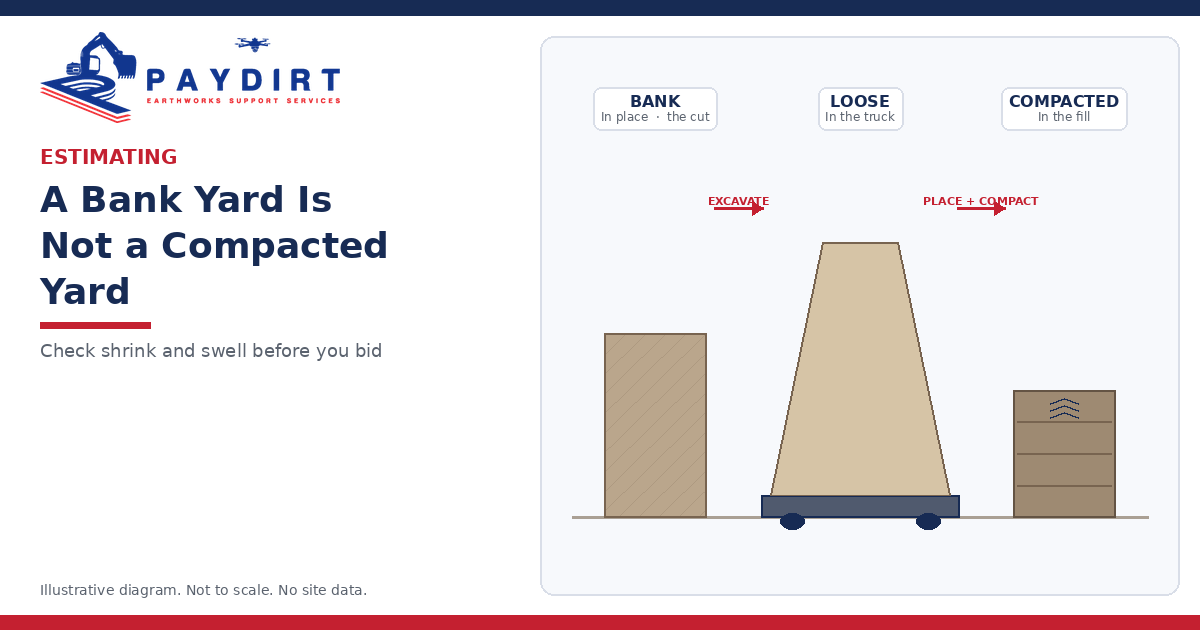
Material changes volume from the cut to the truck to the fill. Here’s what to check in the geotech and the spec before you lock import, export and haul.
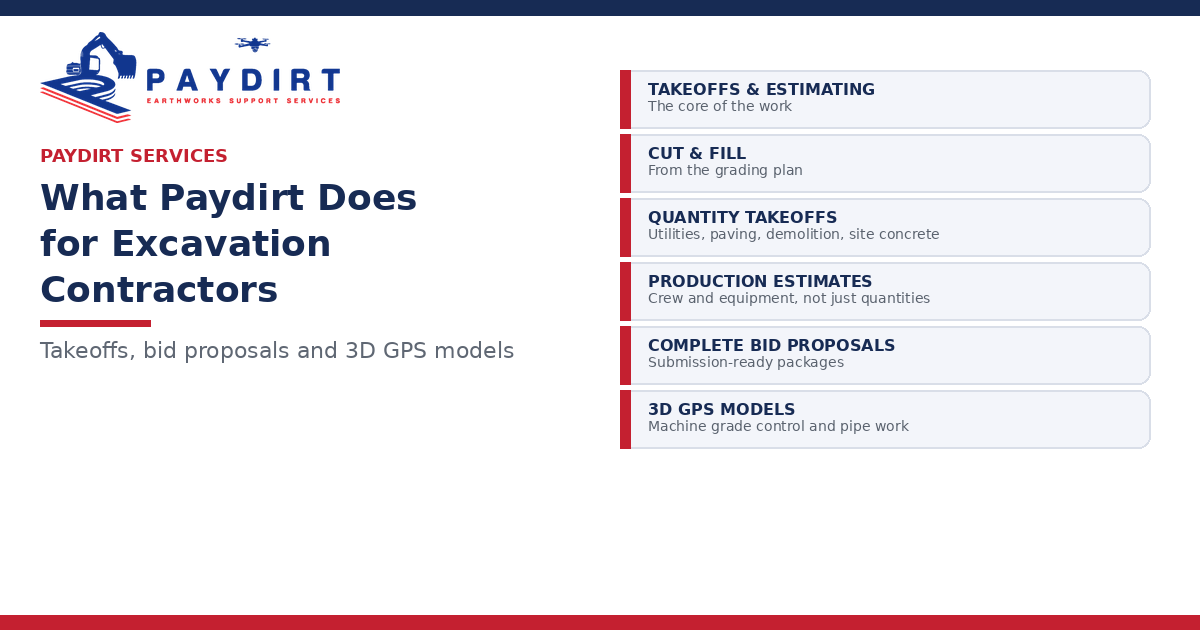
A clear look at what Paydirt does: takeoffs and estimating, production estimates, complete bid proposals and 3D GPS machine control models — with 3 sets of eyes on every project.
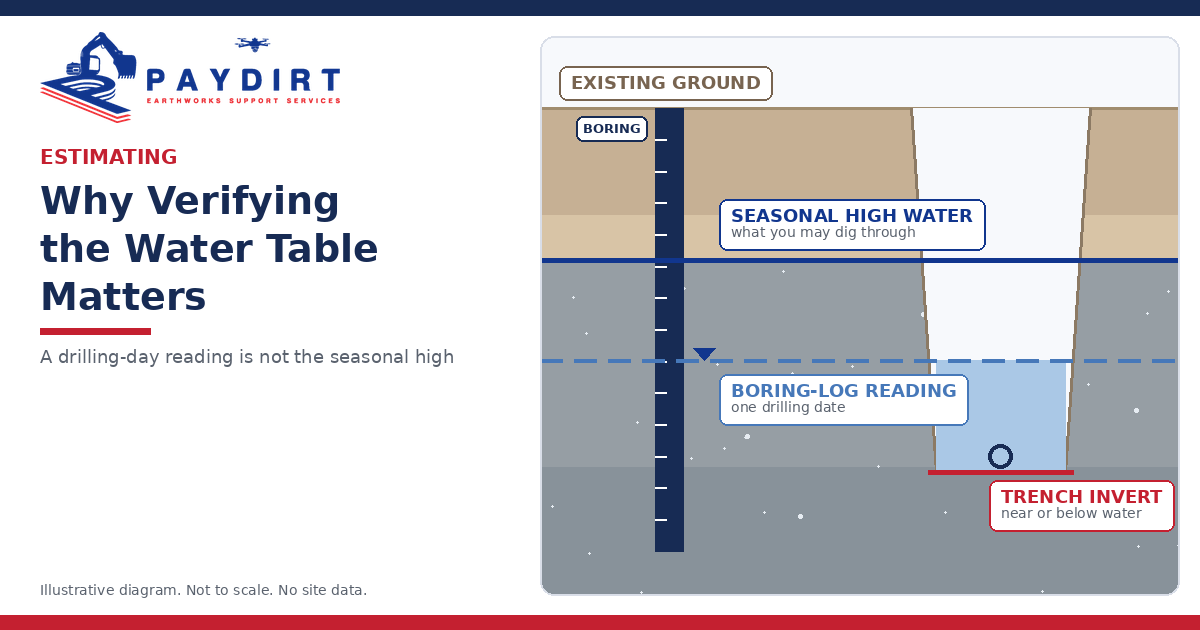
A water level recorded on one drilling date is not the same as the high water you’ll dig through. Here’s what to check before you lock the number.
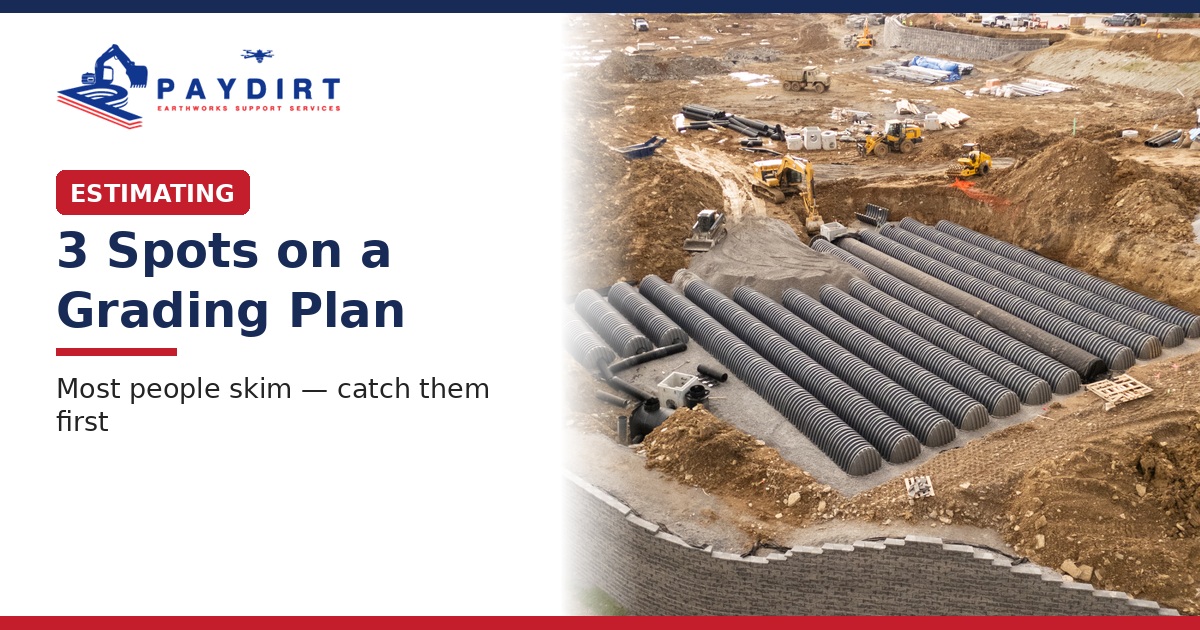
Most cut/fill misses hide in three spots on the grading plan: contours, spot elevations and margin notes. A five-minute desk check before you lock the number.
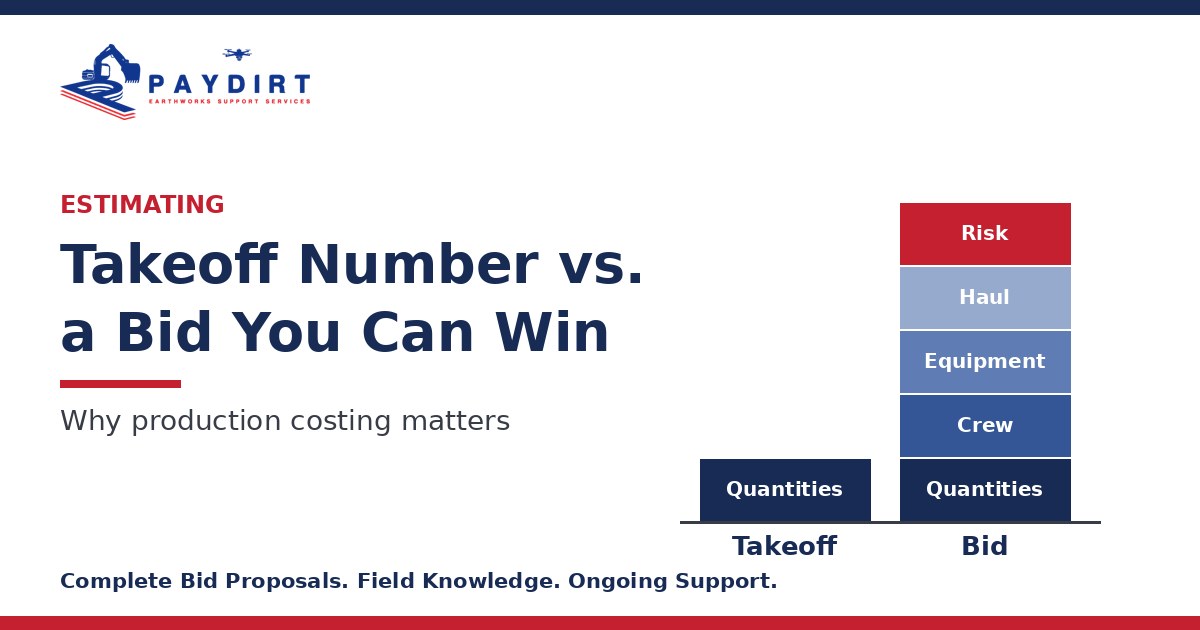
A takeoff tells you how much dirt. Production costing tells you what it costs to move it. Here’s how to turn excavation quantities into a bid you can win.